The Headlands: An International Dark Sky Park
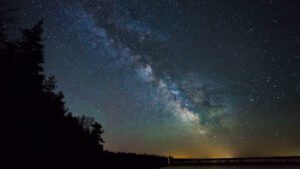
The Headlands, just west of Mackinaw City, is one of six International Dark Sky Parks in the U.S. and one of nine in the world.
Photo by Ed Vázquez on Unsplash.com
Spring brings a number of outdoor activities to Northern Michigan but one with a culinary connection often ends up on pancakes: making maple syrup. Several weeks in March when the days warm to above freezing but the nights deep below freezing are perfect for making syrup. When Northern Michigan’s many maple trees are adorned with taps and buckets, it is a sure sign of spring.
Tapping the trees typically means a snowshoe hike into the woods. The maple trees are drilled and a spout is placed in the hole with a bucket hanging from the spout. The sap is collected daily.
The sap is then boiled in either an outdoor shed called a sugar shack or over a fire or camp stove- yes, outside. It takes 10 gallons of sap to make one quart of syrup so there is a lot of evaporation. Once the liquid hits 212 degrees F, it can be filtered and then bottled.
The early season syrup, the first sap taken from the trees, is lighter in color and flavor and as the weeks pass, the syrup becomes darker. In the U.S. there are two grades of maple syrup, A and B, with A being lighter while B is the darker syrup. Bakers, for example, might prefer Grade B because it adds a bit more sweetness.
Maple syrup “farms” are a part of Northern Michigan and have been for many years. Several date back three or four generations and farms in Charlevoix and Burt Lake are among the biggest in the state.
If you’re in Northern Michigan in March, don’t miss the maple syrup season. And if you are not Up North in March, visit one of our many farm markets to capture some of this golden liquid of spring.

The Headlands, just west of Mackinaw City, is one of six International Dark Sky Parks in the U.S. and one of nine in the world.

The history Northern Michigan’s Inland Water Route is preserved at the Inland Water Route Historical Museum in Alanson.

Wilderness State Park’s 2,582 acres of natural area and 4,492 acres of wilderness area make this a great place to explore all year ’round.

When visiting Northern Michigan, be sure to ride one of the local Lake Michigan ferries. It’s an adventure that should be on every travelers’ Up North bucket list!

Fort Mackinac is open from May-October and includes buildings restored their original look after the fort’s occupation by the British

The history of the fur trade in Northern Michigan is captured at Colonial Michilimackinac in Mackinaw City.